Knowing how long money lasts is an important part of personal financial planning. Whether you are managing a monthly paycheck, living from savings, preparing for retirement, or trying to stretch a limited amount of cash, understanding how long your money can cover your expenses can help you make better financial decisions.
The amount of time your money lasts depends on several factors, including how much you have, how much you spend, whether you earn additional income, inflation, investment returns, taxes, and unexpected expenses. A person with $20,000 in savings could make that money last for several years with very low expenses, while someone spending $4,000 per month could use the same amount much faster.
A how long money lasts calculator can help estimate how many months or years your savings may cover your expenses. However, the calculation is only an estimate because real-life income and expenses can change.
What Does How Long Money Last Mean?
“How long money lasts” generally refers to the amount of time a specific amount of money can support your expenses before the balance reaches zero.
For example, if you have $12,000 in savings and spend $2,000 per month, a simple calculation suggests that your money could cover approximately six months of expenses if you receive no additional income and the money earns no return.
The calculation becomes more complicated when you include income, investment returns, inflation, taxes, irregular expenses, or changing spending habits.
Understanding your personal burn rate, which is the amount of money you spend over a specific period, is one of the most useful ways to estimate how long your available funds may last.
How Do You Calculate How Long Money Will Last?
A simple calculation is to divide your available money by your average monthly expenses.
Months Money Lasts = Available Money ÷ Monthly Expenses
For example, if you have $15,000 saved and your monthly expenses are $2,500:
$15,000 ÷ $2,500 = 6 months
Under these simplified assumptions, your money could cover approximately six months.
This calculation assumes that you have no additional income, your expenses remain constant, and your savings do not earn interest. Real-world situations are usually more complicated, so a more detailed calculation may produce a different result.
How Long Will $10,000 Last?
How long $10,000 lasts depends primarily on your monthly spending.
If you spend $1,000 per month, $10,000 could theoretically cover 10 months. At $2,000 per month, it could cover approximately five months. At $2,500 per month, it could cover about four months.
| Monthly Spending | Approximate Time $10,000 Lasts |
|---|---|
| $500 | 20 months |
| $1,000 | 10 months |
| $1,500 | 6.7 months |
| $2,000 | 5 months |
| $2,500 | 4 months |
| $3,000 | 3.3 months |
These figures are simple estimates and do not account for investment returns, inflation, taxes, or unexpected expenses.
The example demonstrates why controlling monthly expenses can have a major effect on how long savings last.
How Long Will $20,000 Last?
With $20,000 available, the time your money lasts depends on your monthly spending rate.
If your expenses are $2,000 per month, the money could theoretically cover 10 months. At $3,000 per month, it could cover approximately 6.7 months. If you spend $4,000 per month, it could last about five months.
Reducing expenses can significantly extend the life of your savings. For example, reducing monthly spending from $4,000 to $3,000 increases the number of months that $20,000 could cover.
This is why calculating your essential expenses separately from discretionary spending can be useful when determining how long your money may last.
How Long Will $50,000 Last?
A $50,000 balance can provide very different levels of financial support depending on your lifestyle.
At $2,000 per month, $50,000 could cover approximately 25 months of expenses under a simple no-income assumption. At $3,000 per month, it could cover approximately 16.7 months. At $5,000 per month, it could cover about 10 months.
However, a large savings balance should not automatically be treated as spending money. Some of your savings may be reserved for emergencies, taxes, major purchases, healthcare costs, or other financial goals.
Understanding what portion of your savings is actually available for spending is essential when estimating how long your money will last.
How Long Will $100,000 Last?
A $100,000 savings balance can potentially support expenses for several years if spending is relatively low, but the actual period varies considerably.
At $2,500 per month, a simple calculation gives approximately 40 months, or about 3.3 years. At $4,000 per month, the same amount would cover approximately 25 months.
If the money is invested and earns a return, it may last longer than a simple cash calculation under favorable conditions. However, investments can also decline in value, so investment returns should not be treated as guaranteed income.
Taxes, inflation, fees, and changing expenses can also affect the actual result.
How Long Will Money Last Without a Job?
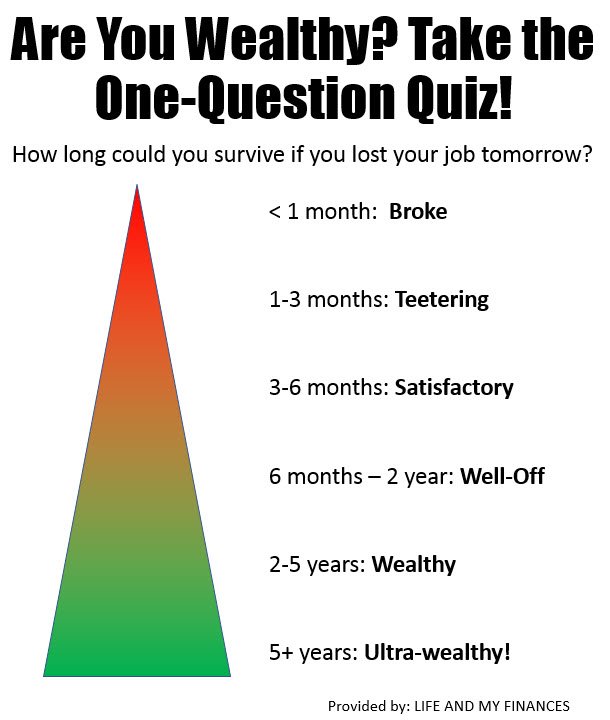
If you are between jobs, determining how long your savings can last becomes especially important.
Start by calculating your essential monthly expenses. These may include housing, utilities, food, transportation, insurance, debt payments, and healthcare.
Then identify expenses that could potentially be reduced temporarily. Dining out, entertainment, travel, subscriptions, and other discretionary expenses may be adjustable depending on your circumstances.
Divide the amount of money available for spending by your revised monthly expenses. This gives you a basic estimate of your financial runway.
For example, if you have $18,000 available and reduce your essential monthly expenses to $3,000, the simple calculation suggests six months of coverage.
This calculation can help you understand how urgently you may need to replace lost income.
How Long Does an Emergency Fund Last?
An emergency fund is generally designed to cover unexpected expenses or a temporary loss of income.
The amount of time an emergency fund lasts depends on whether you are using it for a single unexpected expense or for ongoing living costs.
If you lose your job, for example, an emergency fund may need to cover housing, food, utilities, transportation, insurance, and other essential expenses until you find another source of income.
A useful approach is to calculate your essential monthly expenses rather than your total lifestyle spending. This can show how many months your emergency savings could support your basic needs.
The appropriate emergency fund varies by individual circumstances, including income stability, employment situation, household size, and access to other resources.
How Long Will Retirement Money Last?
Retirement planning requires a more detailed calculation because the goal is often to make money last for many years or decades.
The amount of retirement savings you need depends on your spending, income from other sources, investment returns, inflation, taxes, withdrawal strategy, and expected retirement length.
For example, someone spending $30,000 per year will generally have different retirement needs from someone spending $80,000 per year.
Retirement income may come from multiple sources, including government benefits, pensions, investment accounts, savings, rental income, or part-time work.
Because retirement can last for decades, simply dividing savings by annual expenses may not provide a reliable long-term estimate. Investment growth and inflation can significantly change the calculation.
How Inflation Affects How Long Money Lasts
Inflation can reduce the purchasing power of money over time. If the cost of goods and services increases, the same amount of money may purchase fewer products and services in the future.
For example, if your expenses currently total $3,000 per month, your future expenses may be higher if prices rise over time.
This is especially important for retirement planning and long-term financial goals. A calculation that assumes expenses remain unchanged may overestimate how long your money will actually last.
When creating a long-term projection, consider using an inflation assumption and reviewing your spending periodically.
How Investment Returns Affect How Long Money Lasts
Investment returns can potentially extend the life of a portfolio because money that remains invested may generate additional returns.
For example, if you have $100,000 invested and withdraw a portion each year, the remaining balance may continue to grow if investment returns exceed withdrawals.
However, investment returns are not guaranteed. Markets can rise and fall, and a portfolio can lose value.
The timing of investment gains and losses can also matter. Large market declines early in retirement, combined with regular withdrawals, can have a significant effect on how long a portfolio lasts.
For this reason, retirement calculations often use multiple scenarios rather than assuming one fixed annual return.
How Spending Affects How Long Money Lasts
Your spending rate is one of the most important factors determining how long money lasts.
Reducing recurring expenses can extend your financial runway without requiring additional income. Housing, transportation, debt payments, food, insurance, and subscriptions can all affect monthly cash flow.
For example, reducing monthly expenses from $4,000 to $3,000 decreases annual spending by $12,000.
If you have a fixed amount of savings, reducing expenses can therefore significantly increase the number of months or years your money can support you.
This does not mean every expense should be eliminated. The goal is to understand which expenses are essential and which can be adjusted when necessary.
How Additional Income Can Make Money Last Longer
Additional income can significantly extend the life of your savings.
Part-time work, freelance income, business income, rental income, pension payments, government benefits, or other sources of cash flow can reduce the amount you need to withdraw from savings.
For example, suppose your monthly expenses are $3,000 and you have $20,000 in savings. If you earn $1,500 per month, you only need to withdraw approximately $1,500 from savings to cover the remaining expenses, assuming the income and expenses are stable.
This can make the savings last much longer than they would if you had no income.
How to Make Money Last Longer
There are several practical ways to extend the life of your money. The first is to understand your spending. Tracking expenses can reveal where your money is going and identify areas where reductions may be possible.
Reducing recurring expenses can be particularly effective because the savings occur every month. Reviewing subscriptions, insurance costs, transportation expenses, debt payments, and other recurring bills can help lower your monthly spending.
You can also prioritize essential expenses and temporarily reduce discretionary spending when your income is uncertain.
Building additional income is another option. Even a modest amount of recurring income can reduce the amount you need to withdraw from savings.
Finally, maintaining a separate emergency fund can help prevent unexpected expenses from consuming money intended for regular living costs.
How Long Money Lasts in Retirement
Retirement is one of the most common situations where people ask how long their money will last.
A retirement calculation should consider the starting portfolio balance, annual withdrawals, expected investment returns, inflation, taxes, and other income sources.
For example, someone with $500,000 in retirement savings and $30,000 in annual withdrawals has a very different financial situation from someone with the same savings but $60,000 in annual withdrawals.
The amount withdrawn relative to the portfolio size is an important consideration, but there is no universal withdrawal rate that guarantees a portfolio will last for every retiree.
Retirement planning should account for changing expenses and uncertain investment returns rather than relying on one fixed projection.
How Long Money Lasts With Monthly Withdrawals
Monthly withdrawals can be modeled using a more advanced financial calculation that considers the starting balance, withdrawal amount, investment return, and inflation.
For example, someone with $200,000 who withdraws $2,000 per month is making annual withdrawals of $24,000 before considering inflation or investment returns.
If the portfolio earns no return, the simple calculation suggests that the initial balance would cover approximately 8.3 years.
With investment returns, the result could be different. If returns are negative, the money could run out sooner. If returns are positive, it could potentially last longer.
This illustrates why financial projections should consider multiple possible outcomes.
How a How Long Money Last Calculator Works
A how long money lasts calculator typically asks for several inputs, such as your current savings, monthly spending, monthly income, expected investment return, inflation rate, and sometimes taxes.
The calculator then estimates how the balance could change over time.
A basic calculator may simply divide savings by monthly expenses, while a more advanced retirement calculator may model investment growth, recurring withdrawals, inflation, and other variables.
The more assumptions a calculator includes, the more detailed the projection can become. However, more complex calculations do not eliminate uncertainty.
The result should be viewed as an estimate rather than a guarantee.
Common Mistakes When Estimating How Long Money Will Last
One common mistake is assuming that expenses will remain exactly the same forever. Housing, healthcare, food, transportation, and other costs can change over time.
Another mistake is ignoring inflation. Even moderate inflation can significantly affect purchasing power over long periods.
People may also assume that investments will earn a fixed return every year. Actual returns fluctuate, and investments can lose value.
Ignoring taxes is another potential problem. The amount you can actually spend may be lower than your gross income or investment withdrawal.
Finally, unexpected expenses can shorten the life of savings. Building a realistic buffer into your financial plan can help account for uncertainty.
Final Thoughts on How Long Money Lasts
The answer to how long money lasts depends on the relationship between your available money, spending, income, investment returns, inflation, and unexpected expenses.
A simple calculation can provide a starting point: divide your available money by your monthly expenses. However, this approach works best for short-term estimates and assumes that spending and income remain stable.
For longer-term planning, especially retirement, a more detailed calculation should account for investment returns, inflation, taxes, withdrawals, and changing expenses.
The most effective way to extend the life of your money is to understand your spending, control unnecessary expenses, maintain appropriate savings, and develop reliable sources of income where possible.
A financial calculator can help you explore different scenarios, but no calculator can predict the future with certainty. Review your assumptions regularly and update your plan as your income, expenses, and financial goals change.